AI Is Changing App Store Search: ASO Needs to Adapt

AI Is Changing App Store Search: ASO Needs to Adapt
If your app's organic visibility has felt harder to predict lately, you're not alone. Rankings shift in ways that don't line up with metadata changes. Reliable keywords deliver less consistent traffic. And search results now include a broader, sometimes surprising, mix of apps.
AI tends to get the blame, usually without much specificity. The reality is more layered. App stores aren't being rebuilt around AI. But the systems that decide which apps show up for which queries are getting meaningfully smarter about interpreting what users actually want. That has practical consequences for how ASO needs to work going forward.
What AI is Actually Changing in App Store Search
The changes happening under the hood are not headline-grabbing launches. They're quiet upgrades to how search systems process language and evaluate meaning.
Natural language processing, machine learning, and embedding models have powered various parts of app store infrastructure for years, handling tasks like categorization, review analysis, and keyword grouping. The difference now is capability. These systems have become significantly better at reading context, connecting related phrases, and making educated guesses about what a person is really after when they type a query.
Where app store search used to rely heavily on character-level keyword matching, it's now moving toward understanding the relationship between words, concepts, and user needs. That's a fundamental shift in how relevance gets calculated.
The practical consequence for app owners: you don't need to "optimize for AI." You need to recognize that discovery is increasingly driven by how well your app's full store presence communicates what it does and who it's for.
From Keyword Matching to Semantic Relevance
ASO has traditionally been mechanical. Research keywords, place them in the right fields, rank for those terms. The input-output relationship was fairly direct.
That's changing. App store search is evolving from literal string matching to something closer to semantic understanding. When someone types "app to help me sleep," the system can now surface results using completely different phrasing, like "bedtime routine planner" or "relaxation sounds," because it recognizes the underlying need rather than just scanning for character overlap. A single search term can now trigger results across several different need states, and ranking decisions reflect that complexity.
Evidence points to these changes rolling out unevenly. English-language stores, particularly in the U.S., show the strongest signals. Other markets and languages appear to be at earlier stages, which means the pace of impact will vary depending on where your app competes.
One visible example appeared in early June 2025, when the iOS App Store's search algorithm was updated. Before the change, searching "college" in the U.S. store produced results dominated by a single type of app. Afterward, the results diversified noticeably: student discount apps, campus search tools, learning platforms, and social apps all started appearing alongside each other.
The platform wasn't just matching a word anymore. It was recognizing that "college" carries several different motivations and trying to serve them all. For app owners, this means sharing result pages with entirely different types of apps, not because your keyword strategy failed, but because the store now acknowledges that one term can mean many things.
How Google Play is Splitting Search Into Intent Paths
Apple isn't the only platform making this shift. Google Play rolled out Guided Search in 2025, a feature that actively helps users narrow broad queries into more specific directions.
Rather than dumping users into one long results list, the store presents refinement options that steer them toward what they're actually looking for. Someone searching "fighting games" might be guided toward "arcade fighting games" or "beat 'em up games." Those look similar on the surface, but they carry very different expectations about gameplay, pacing, and style. The apps that perform well in one path may not even appear in another.
This changes the competitive equation. Ranking for a broad head term matters less if the platform is funneling users into narrower intent channels before they ever see your listing. Your app needs to show up and make sense within the specific paths where your target users end up.
For app owners who have built their strategy around a handful of high-volume terms, this is a wake-up call. The store is actively redistributing that traffic based on inferred intent, and the apps that win will be the ones positioned clearly enough to remain relevant after the split.
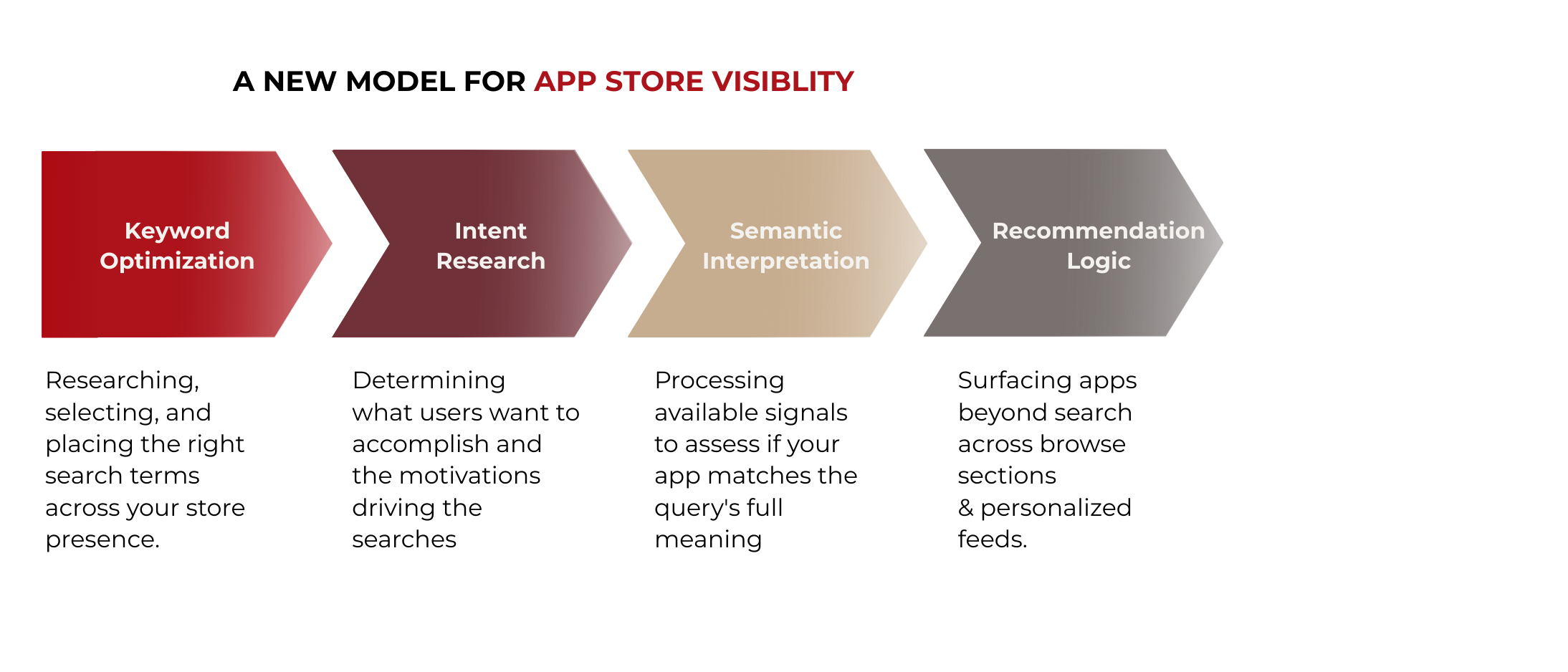
A New Model for App Store Visibility
Visibility used to be about keywords. Now it's about whether platforms understand your app well enough to connect it with the right users at the right moment.
Four forces shape how that works in practice:
Keyword optimization is still the foundation. Researching, selecting, and placing the right search terms across your store presence remains essential.
Intent research asks a different question: not just what people type, but what they're trying to accomplish and why. Two people using the same keyword can have completely different goals.
Semantic interpretation is how platforms process all available signals to figure out what an app is about and how well it matches a given query. This is the layer evolving fastest.
Recommendation logic determines how apps get surfaced beyond search, across browse sections, personalized feeds, and AI-mediated discovery surfaces.
This extends well past the app stores. People now discover apps through AI chatbots, voice assistants, and curated feeds that infer needs from context rather than keywords. The apps that are easiest for these systems to understand and recommend will compound their visibility advantage over time.
What To Do: Practical Steps for Intent-Informed ASO
None of this means throwing out your current approach. It means adding a layer of intent thinking to everything you already do. The goal is straightforward: move from optimizing for individual terms toward building a store presence that communicates clear, consistent relevance to the user motivations behind those terms.
Organize keyword research around intent
Keyword research still drives ASO. But the way keywords are grouped and prioritized needs to account for the different motivations behind them.
Combine your standard intelligence data (traffic estimates, difficulty scores, ranking position) with strategic attributes: how closely a term aligns with your app, what type it is (brand, generic, or competitor), and which user need it maps to. These two dimensions together, discoverability potential and strategic priority, should guide every keyword decision.
The critical distinction is between topic-level themes and the specific motivations within them. "Fitness" is a theme. "Workout app," "knee rehab exercises," and "running watch sync" all fall under it, but each represents a different user with a different goal. Treating them as a single target misses the nuance that determines whether your app feels relevant to the person searching.
Group keywords into thematic clusters, then identify the distinct intents within each one by looking for modifiers like "free," "offline," "beginner," or problem-specific language. Prioritize based on a combination of traffic opportunity, competitive difficulty, and how well the intent matches what your app actually delivers. High-fit terms anchor your metadata. Lower-relevance terms, especially competitor brands, belong in paid campaigns, not your store page.
Revisit this monthly. The landscape shifts, and so should your priorities.
Shape your store page around priority intents
Your title, subtitle, keyword field, and description should tell a coherent story about what your app does and who it's for. If your app serves multiple needs, use custom product pages (iOS) or custom store listings (Android) to create intent-specific entry points. Someone arriving from a brand search expects something different from someone who searched a generic feature term. One default page can't always bridge that gap.
Make screenshots work harder
Screenshots are often the first thing users engage with in search results. When the language and visuals in those screenshots clearly reflect a specific user need, they reduce ambiguity and build confidence faster than text alone.
No one has confirmed that app stores rank apps based on text extracted from screenshots. But the technology to read that text exists, and it's used elsewhere across both iOS and Android. More importantly, screenshots shape how users decide whether an app is worth a closer look. Writing clear, user-facing copy in your visuals that names the problems you solve and the outcomes you deliver improves conversion regardless of how the algorithm treats it.
Use reviews to pressure-test your positioning
Reviews are where users describe your app without any prompting from you. The language patterns that emerge across hundreds of reviews reveal what people value, what confuses them, and where your positioning might be off.
When review language consistently differs from your store page messaging, that's a signal worth acting on. Feed those insights back into your metadata, your screenshots, and your page structure.
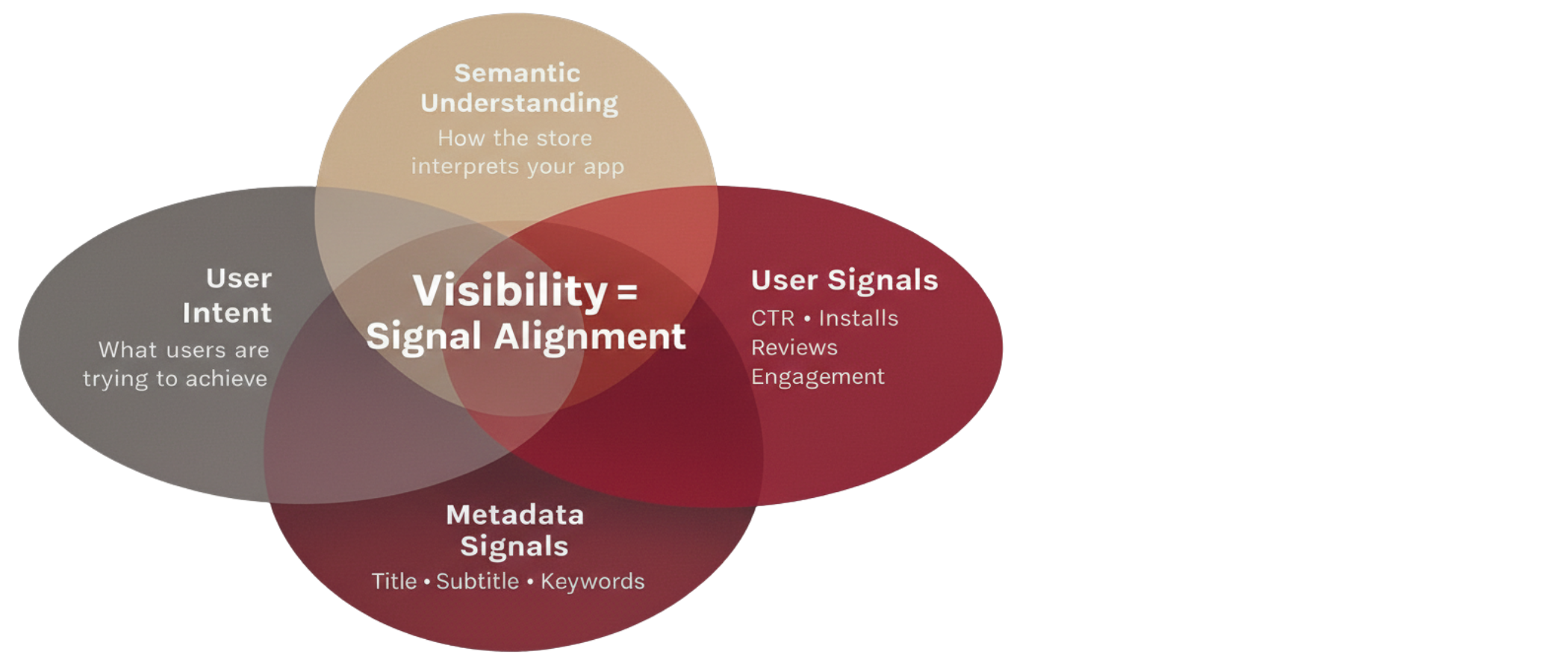
AI evaluates signals together
This is the most consequential shift. When relevance was about keyword matching, each store page element could be optimized independently. In a world where platforms evaluate meaning across multiple inputs, your metadata, screenshots, reviews, and engagement data all contribute to a single picture of what your app is and who it serves.
When those signals point in the same direction, they reinforce each other. When they contradict, the platform's confidence in your relevance drops. Treating your store presence as a connected system, rather than a set of separate optimization tasks, is the clearest competitive advantage available in ASO right now.
What AI Really Means for ASO
AI isn't replacing ASO. It's raising the bar for what counts as relevance.
Keywords still matter. But they work best when they're part of a store presence that consistently communicates what your app does, who it helps, and why it's the right choice for the intent behind any given search. The apps that get this right won't just rank better. They'll be easier for every discovery system, from store search to AI assistants, to understand and recommend.
Visibility now depends on how AI interprets your app, across metadata, creatives, and user signals.
We’re building OWA AI to help teams understand and optimize that system end to end.
- Join the OWA AI waitlist
- Or book a call with us to explore your app’s visibility gaps