What Is a Paywall? Definition, Types, and Why It Matters for App Revenue
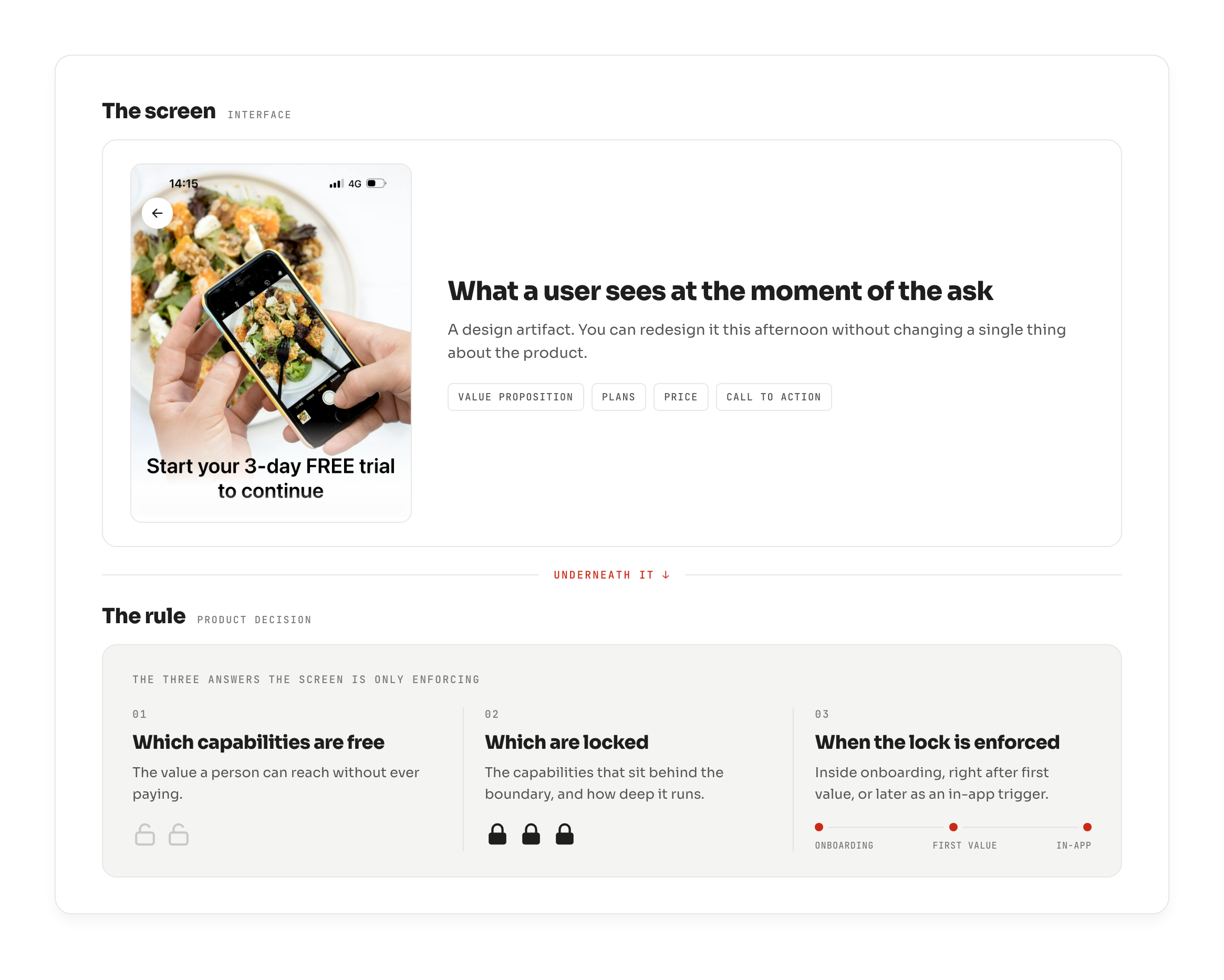
A paywall is the rule that decides how much of your app a person can use before you ask them to pay. Not the screen with the plans and the price button, that is the interface. The paywall itself is the boundary underneath it: which features are free, which are locked, and at what moment the lock is enforced.
Founders use the word loosely, as if it names one thing. "Our paywall converts at 3%" gets said the way you would report a fact. But 3% is unreadable until you know which rule produced it. The same 3% sits below the floor of one kind of paywall and above the median of another, which means it can be a warning sign or a strong result depending on a decision you may not have consciously made. By the end of this piece you will be able to name your paywall type, name where it sits in your flow, and read your own paywall data without being misled by it.
A paywall is a rule, not a screen
The paywall screen is the interface a user sees at the moment of the ask: the value proposition, the plans, the price, the call to action. It is a design artifact. You can change it this afternoon.
The paywall is the rule the screen enforces. It answers which capabilities are free, which are not, and when the boundary is applied. That is a product decision, and it changes far less often, because changing it changes what your product is to a first-time user.
Most attention goes to the screen, because the screen is the visible, movable part, the thing an A/B test can touch by Friday. That is how the word gets used loosely: people talk about the artifact they can change and quietly inherit the rule they cannot see.
The three types: one question, three answers
Every paywall answers a single question: how much value does a person get for free before payment is required? There are three common answers, and they behave differently enough that the shared word "paywall" hides more than it reveals.
Hard paywall: decide at signup
A hard paywall locks the core value. There is no meaningful free use of the product, so the user decides whether to pay at or near signup, before they have lived with the thing.
What it asks you to accept: you give up everyone who was not ready to decide that early, in exchange for deciding fast and monetizing per install. That trade shows up in the numbers. Across RevenueCat's 2026 data, hard paywalls convert downloads to paid at a median of 10.7%, and even the low end of the hard paywall range, a 4.2% floor, is double the freemium median. Both are per-download figures: paid users divided by everyone who installed.
Metered paywall: pick a number you cannot know in advance
A metered paywall gives a fixed quantity of the real product for free, then locks. It is the model The New York Times popularized in 2011, a set number of free articles per month, and apps inherited it as free scans, free workouts, free generations before the wall.
What it asks you to accept: you have to choose the number, and the number is genuinely hard to know beforehand. Set it too generous and most users never reach the wall, so the ask never arrives. Set it too tight and the value never lands before the lock does, so the ask arrives before the user cares. Public benchmark data on metered models is thin next to hard and freemium. Tuning the meter is a craft, not a benchmark.
Freemium: fund a free tier on a belief
Freemium keeps a tier permanently free. Nobody is ever forced to pay. It trades conversion rate for volume, word of mouth, and a base of users who may convert later.
What it asks you to accept: you fund that free tier on the belief that it buys you growth you can actually point to.Whether the trade pays depends on your product, and this piece cannot settle it for you. The useful framing is to ask what the free tier is supposed to return: retention that later converts, referrals, category visibility. Then check whether it does.The efficiency gap is real: freemium apps convert downloads to paid at a median of 2.1%, and revenue per install at Day 60 runs about $3.09 for hard paywalls against $0.38 for freemium, roughly eight times (RevenueCat, State of Subscription Apps 2026). But per-download efficiency is precisely the metric freemium is not trying to win. A freemium app that judges itself on that number is measuring itself against a game it chose not to play.
This is why the same 3% conversion rate means opposite things depending on the rule. Under a hard paywall, 3% sits below the floor and signals a problem. Under freemium, 3% sits above the median and signals the model working. The number did not change. The rule behind it did.
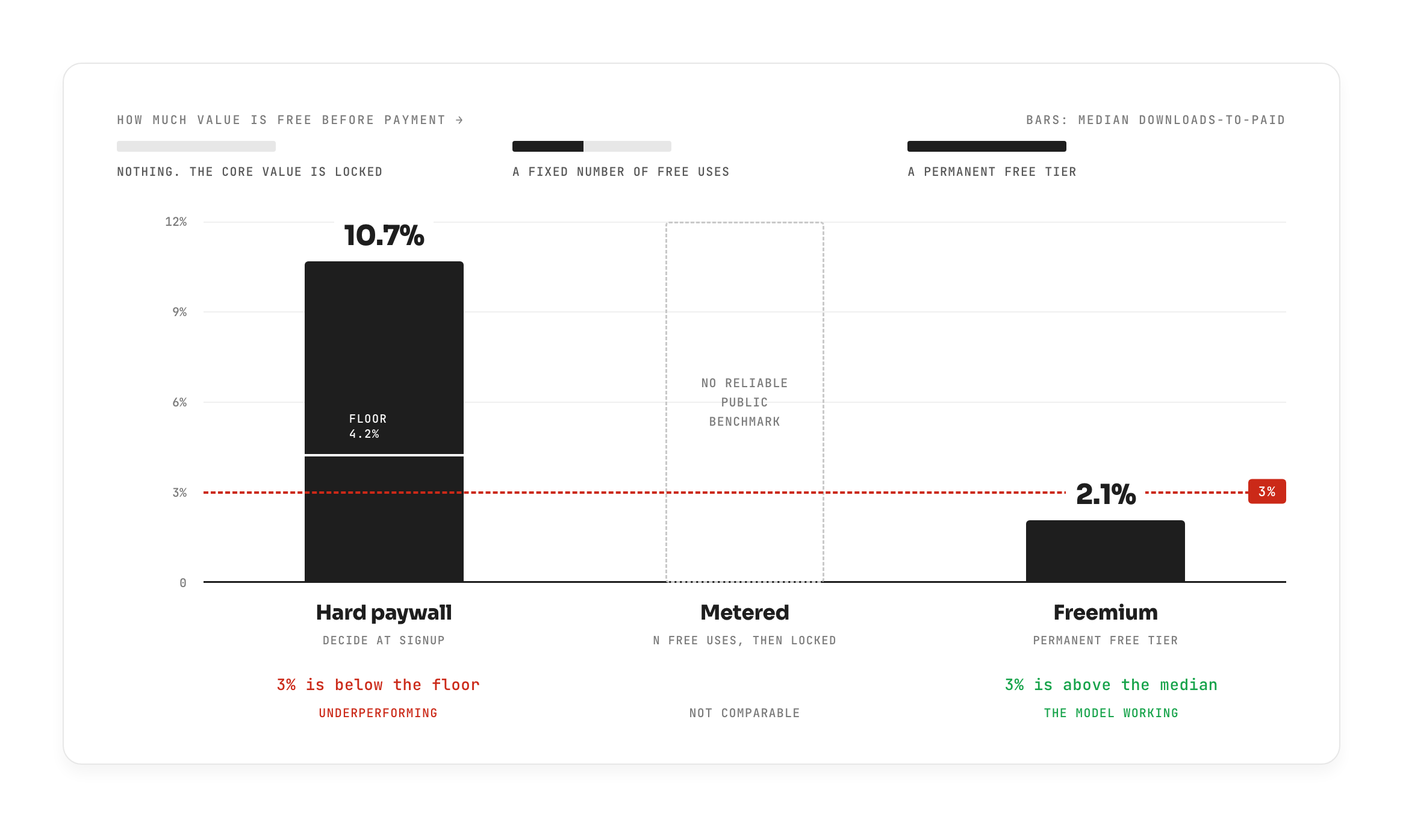
Median downloads-to-paid conversion by paywall type: hard paywalls 10.7 percent with a 4.2 percent floor, freemium 2.1 percent, and no reliable public benchmark for metered. A 3 percent reference line falls below the hard paywall floor and above the
Soft versus hard is dismissibility, not a fourth type
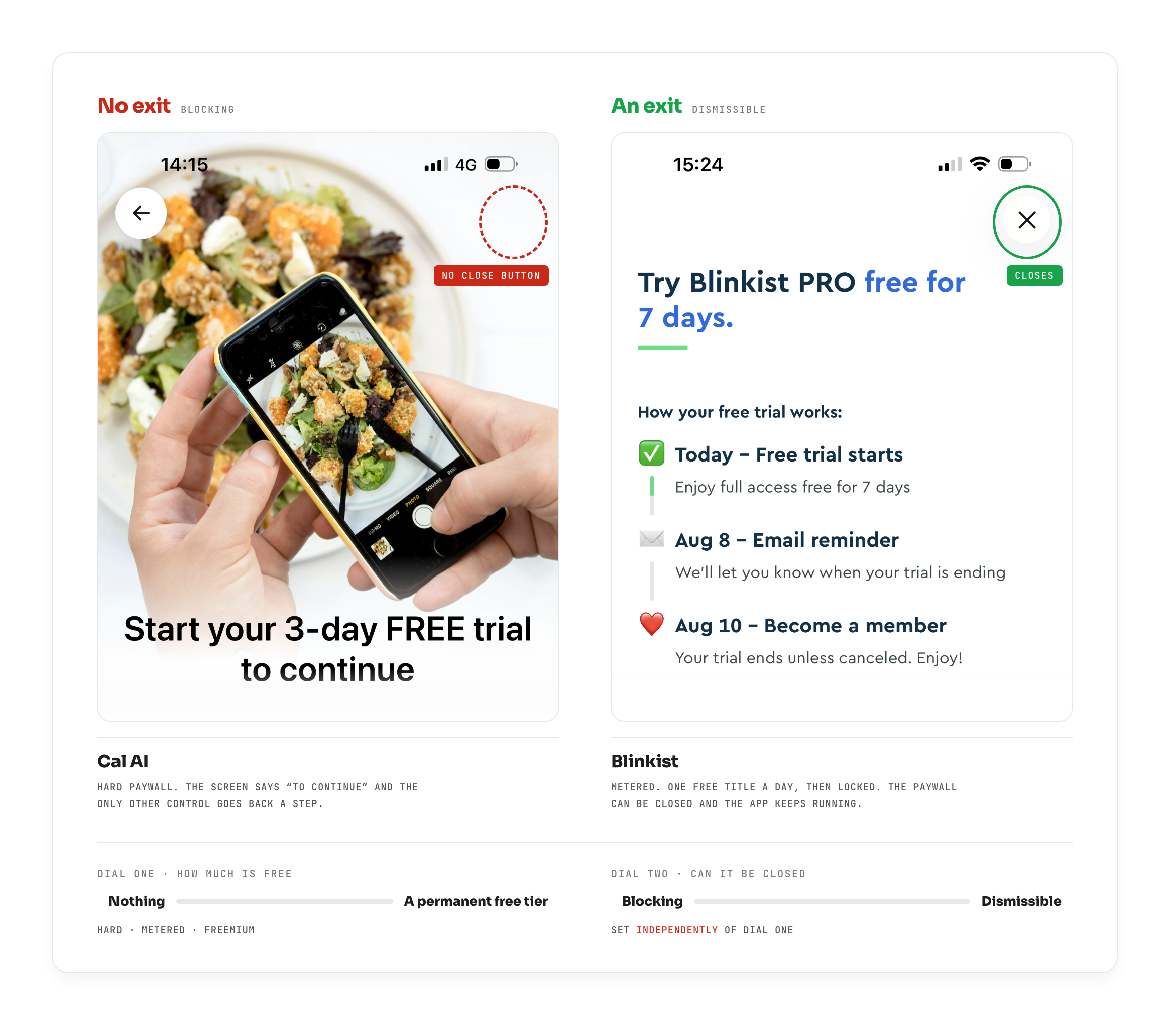
Hard and soft describe one thing only: whether the user can close the screen and keep using the app. A hard paywall blocks; a soft paywall can be dismissed. This is independent of how much value is free. A freemium app can present a blocking screen at a certain boundary, and a metered app can let you wave the screen away and keep going. Dismissibility and free-value-depth are two separate dials.
Getting this straight also explains why paywall benchmarks so often disagree with each other. A dismissible paywall usually looks better on a per-paywall-view basis, because the people who see it are a smaller, warmer group who reached it on purpose. A hard paywall usually looks better per download, because it is shown to everyone who installs, warm and cold alike. Neither figure is wrong, and neither proves one design beats the other. When two sources report different paywall numbers, the first question is not which is right, it is which denominator each one used.
Freemium versus subscription: two questions, not one
These get collapsed constantly, and they are not the same axis. Freemium is an access model: it says how much of the product is free. Subscription is a billing model: it says how you charge for the part that is not.
They stack rather than compete. Most freemium apps sell a subscription for the paid tier, and so do most hard-paywall apps. The true opposite of freemium is a hard paywall. The true alternative to a subscription is a one-time purchase or consumables. So "should we be freemium or subscription" is actually two questions with independent answers, and answering one does not answer the other.
Placement: two axes
Where a paywall sits is a separate decision from what type it is, and it moves along two axes.
When in the flow. A paywall can appear inside onboarding, immediately after the first moment of value, or later as an in-app trigger. The cross-app pattern in Adapty's 2026 data shows onboarding-with-trial placements converting at a median of 1.35% against 0.89% for in-app-with-trial. That is a median across many apps, not a result that transfers to yours.The honest reading underneath it is that willingness to pay tends to concentrate right after a person has felt the product actually work, and that window is short, which is part of why 55% of three-day trial cancellations happen on Day 0 (RevenueCat, 2026). None of that adds up to "put your paywall in onboarding." It says the timing of the ask interacts with when value lands, and that the interaction is yours to find.
How deep. This axis is about which capabilities sit behind the boundary. Set it too shallow and users may never feel enough of the product to want more. Set it too deep and users may get exactly what they came for and never encounter a reason to pay. Both are failure directions, and there is no correct depth to name, because the right line runs through your specific product and the job users hire it for.
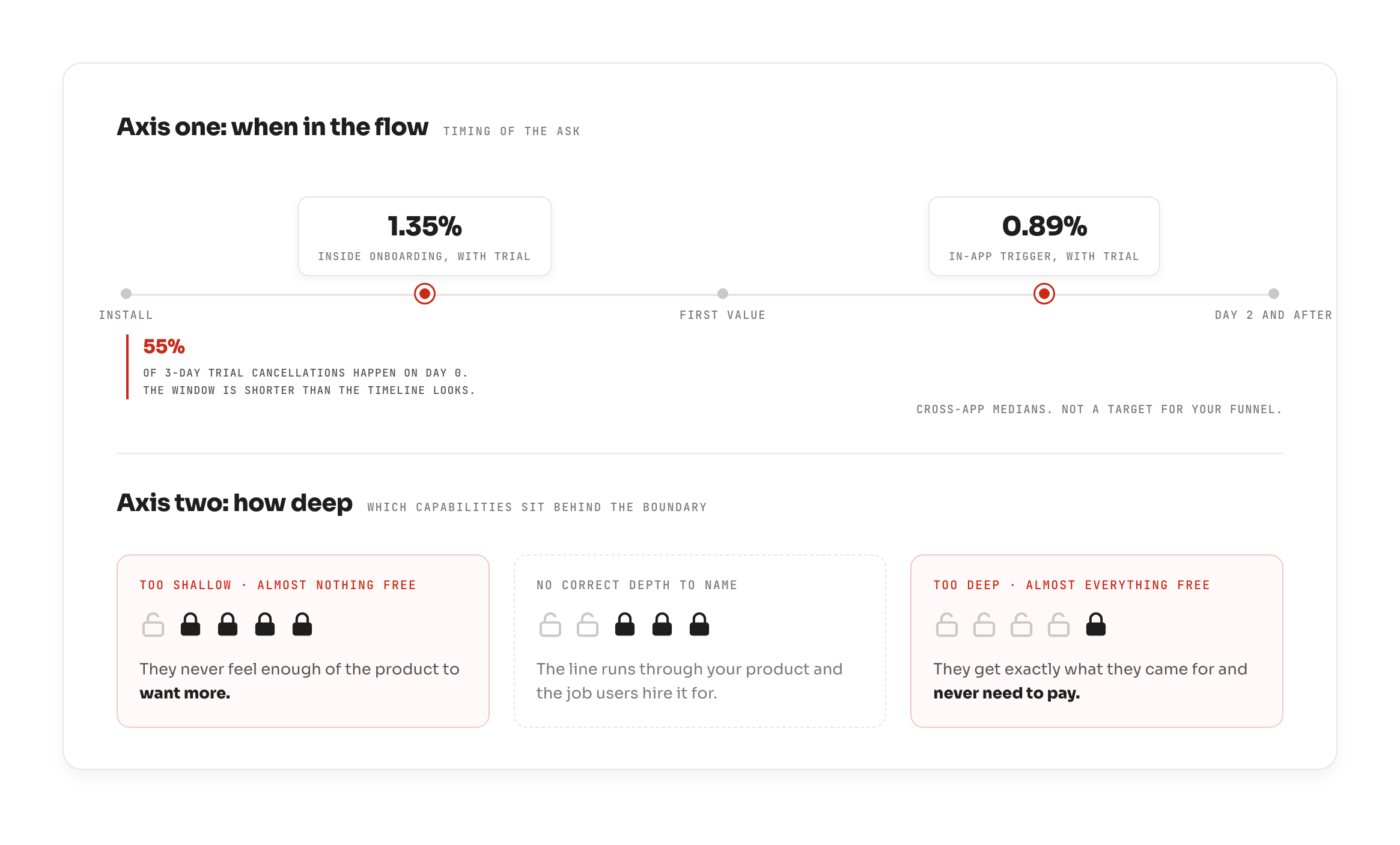
Two placement axes for a paywall: when in the flow, where onboarding-with-trial converts at 1.35 percent versus 0.89 percent in-app, and how deep, showing the failure directions at both extremes with no correct depth named.
How to reason about the choice
There is no universal winner among these models. Each asks you to accept a different tradeoff, and the same model performs differently by category, traffic source, and how long your product takes to deliver its value. A model that works when value lands in ten seconds can fail when it takes a week.
So the choice is one to make deliberately and then test against your own numbers, not one to inherit from someone else's benchmark. Name the type you are running. Name where it sits in your flow. Understand what that combination costs you. Then change it on purpose, if you change it at all.
FAQ
What are paywalls?
A paywall is the rule that governs how much of an app or service a person can use for free before payment is required. It defines which features are accessible without paying, which are locked, and when the boundary is enforced. The term is often used to mean the screen that presents plans and prices, but strictly the paywall is the underlying access rule, and the screen is its interface.
What is a paywall screen?
A paywall screen is the interface a user sees when asked to pay: the value proposition, the available plans, the price, and the call to action. It is a design artifact that can be edited or A/B tested without changing the product. It is distinct from the paywall itself, which is the rule about what is free and what is locked. Two apps can run identical paywall screens over completely different paywall rules.
What is the difference between a hard and soft paywall?
Hard versus soft describes whether the user can dismiss the screen and continue using the app. A hard paywall blocks access until the user pays or leaves. A soft paywall can be closed, letting the user continue with limited access. This is separate from how much value is free: a freemium app can show a blocking screen, and a metered app can show a dismissible one. Dismissibility and free-value-depth are independent choices.
Does freemium count as a paywall?
Yes. Freemium is one of the three common paywall types, alongside hard and metered. It sets the free-value boundary at a permanently free tier, meaning no user is ever forced to pay, while paid features sit behind the boundary. It is still a paywall because it enforces a rule about what is free and what is not. Its opposite is a hard paywall, which locks the core value entirely.
Where this leaves you
The type and the placement set the ceiling on what an install can be worth to you. Everything you do on the screen decides how much of that ceiling you collect. That is why the same conversion figure means different things in different apps, and why the number in your dashboard stops being a verdict and starts being a reading once you can name the rule behind it.
This piece decides what your paywall is. The next layer down decides what it looks like: single-page versus multi-step structure, which levers actually move the number, and how often to test. Read this to name your type, read Paywall Design in 2026: Single-Page vs Multi-Step to design the screen.